Statistics

Probability distributions that aren’t Normal

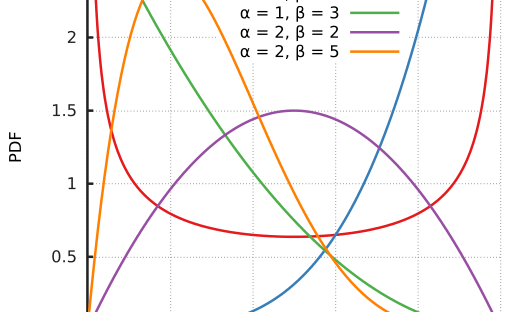
Many people are aware of the normal distribution or "bell curve". What are some other probability distributions and when are they useful? You can think of a probability distribution as a collection of the number of times something happened. For example, how many students get which grade (70%, 73%, 94%, etc). We can visualize this… Continue reading Probability distributions that aren’t Normal

Computation, Data analysis, Misc, Statistics

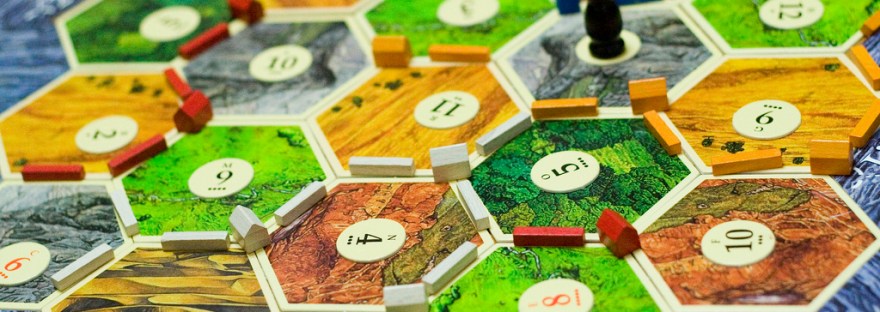
Random Chance in Settlers of Catan

Games of chance are often people’s first exposure to statistics. Settlers of Catan is a game that revolves around the probability distribution of two independent 6-sided die rolls. The game consists of hexagons with one of four possible resources available. These hexagons are normally in a random configuration. Each hexagon receives a random number token.… Continue reading Random Chance in Settlers of Catan

Data analysis, Statistics

Introduction to Bayesian Statistics, Part 1

In Part 1, we will discuss how to use Bayesian statistics for data analysis. When to use Bayesian statistics Low sample size Bayesian statistics are useful when you have low sample sizes. Most frequentist statistics involve assumptions about the variance of your data. These assumptions are not very good when you are working with low… Continue reading Introduction to Bayesian Statistics, Part 1

Misc, Visualization

Converting pdf to print-quality 600dpi image without Photoshop

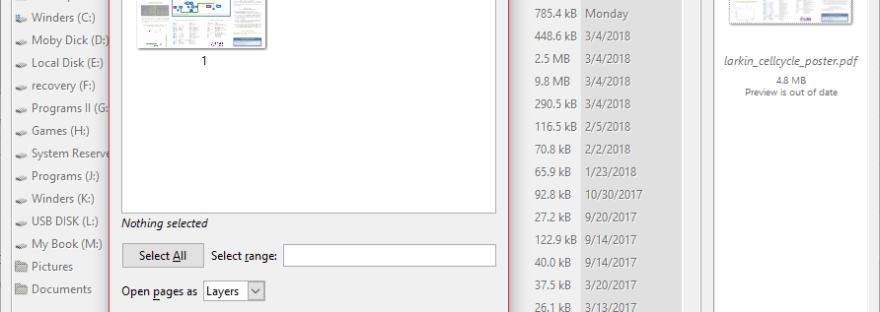
For a poster or publication it may be necessary to submit images with 600 dpi for the best print quality. I use GIMP (download here) to convert pdfs without having to buy Photoshop. GIMP works for any platform. First import your pdf. Check that the width and height of the pdf is correct, as well as… Continue reading Converting pdf to print-quality 600dpi image without Photoshop

Misc, Visualization

How to make print-quality figures in Matlab 

I use Matlab to run many of my simulations and as a substitute for Excel. One of the best things about making figures in Matlab is you can capture the figure screen after fixing any minor details like background color or text size. You can also manually resize the window to make a square or… Continue reading How to make print-quality figures in Matlab 

Uncategorized

A 3-click solution to improving the work/life balance of others

Alex Bond's avatarThe Lab and Field

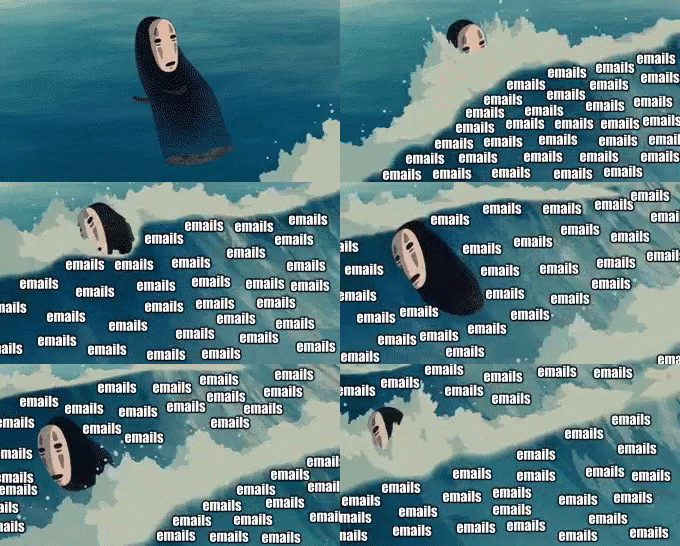
I think it’s safe to say a good number of us struggle with the large amountconsiderable volume overwhelming flood of email.
emails

And many of us have implemented solutions, and there’s been lots of discussion about how to stem the tide that washes over us almost daily (see this post & the comments over on Dynamic Ecology). But ultimately, the problem starts with each of us as individuals, and the volume of email we send, and when we send it. For those of us who have staff, students, or other trainees, the latter can often send a not-so-subtle message.

With near-constant connectivity comes an expectation of immediate responses. Many of us have email on our phones, or spend most of our working day sitting at a computer with our email client/web page open, where it bings and chimes with each incoming message. Two years ago, I started tracking the…
View original post 506 more words

Uncategorized

PLOS One publishes near-copy of retracted JBC paper, sans coauthor Carlo Croce

Leonid Schneider's avatarFor Better Science

On July 29th 2016, Journal of Biological Chemistry (JBC) retracted a cardiology paper from 2009 for data manipulations. Only some days later, on August 20th 2016, the corresponding authors Sathyamangla Naga Prasad andSadashiva Karnik (both from the same Department of Molecular Cardiology at Cleveland Clinic in Ohio, US, submit that same paper, under same title, with only some changes, to PLOS One. All authors remained the same, only two mysteriously fell off the paper: George Calin and his former mentor Carlo Croce. The latter is a notorious cancer researcher from Ohio State University, PubPeer star accused of misconduct and author on 7 retracted papers (according to the new Retraction Watch database). Croce even made it into New York Times, which he now sues, together with his critic David Sanders. (some more details here).

It makes sense why Prasad and Karlin decided to…

View original post 760 more words

Uncategorized

Peer review ghost-writing, or do professors understand plagiarism?

Leonid Schneider's avatarFor Better Science

Every academic will probably agree that plagiarism is wrong. It is absolutely not OK to pass someone’s else’s intellectual work as one’s own. Plagiarised research papers get retracted regularly, on several occasions plagiarism in dissertation led to withdrawal of doctorate, most notably among several German politicians. There is however one aspect of academic life where plagiarism is so normal that the parties involved  do not even consider it to be plagiarism, neither the plagiarist, nor the victim of plagiarism. It is the academic peer review, the process where research colleagues are invited by journal editors to submit their expert opinion on the scientific quality of the manuscript under editorial consideration. and it is not the incompetent youth plagiarising there, but professors, principal investigators (PIs), research institute directors and clinic heads. Our academic elite plagiarises daily, without anyone even raising an eyebrow. 

View original post 1,419 more words